HydraTite Internal Joint Seal – Bulk Water Supply
Following the successful installation of a 2200 mm diameter HydraTite® Internal Joint Seal by Interflow Pty Ltd in April 2023 (check out the 2023 case study “HydraTite Internal Joint Seal for Water Supply”)—effectively sealing the leaking pipe joint—WaterNSW approved the expansion of the leak repair program.
This case study examines the application of HydraTite® Internal Joint Seals to rehabilitate an additional six joints within ageing critical infrastructure, building on the proven performance of the initial installation
The Problem
WaterNSW & their specialist repair contractor Interflow Pty Ltd faced a range of challenges which included leaking joints at the interfaces between 2 different shapes (open channels transitioning into pipes at river crossings), differing expansion and contraction due to dissimilar pipe & channel materials and a limited window of time during which the system could be offline to install the seals.
While the channels are concrete, the pipes crossing the creeks & rivers are ductile iron and the expansion and contraction of dissimilar materials has been an ongoing source of leaks at the joints which range from approximately 2100 to 2400mm diameter at different locations in the network.
The deteriorated condition of the concrete channel and headwall added to the complexity of the problem
The Solution
With the original installation in April 2023 (see Figure 2) demonstrating the suitability and success of HydraTite® to seal the leaks, WaterNSW approved the use of the HydraTite® Seals for an additional 6 creek crossings in the network with installation conducted during a scheduled maintenance shutdown in late 2025.
HydraTite® Internal Joint seals were originally selected for their strength, flexibility and strong history in the US for sealing large diameter pipes.
Interflow employed the same successful strategy and methodology for the additional 6 locations with the custom made HydraTite® seals individually sized for each of the different locations
Preparation (see Figure 3) included removal of old & degraded material and concrete to achieve a solid substrate. A suitable mortar was then used to reprofile and buildup the channel and headwall creating a platform for the HydraTite® to seal between the pipe and open channel
After reprofiling the deteriorated channel and headwall, a Double Wide EPDM rubber seal (approx. 2100-2400mm diameter, sized for the specific location) was installed, with 2 stainless steel retaining bands positioned (one in the smaller diameter pipe and the second on the larger diameter profiled section) to locate the EPDM rubber seal in the correct position as shown in figures 4 & 5
With the correct positioning of the seal and retaining bands confirmed, the third and fourth stainless steel retaining bands were positioned and all retaining bands expanded to finalise the installation as shown in figure 5.
The end result was all 6 additional HydraTite® Joint Seals successfully installed and the system recommissioned.
Download the full case study from the HydraTite page.
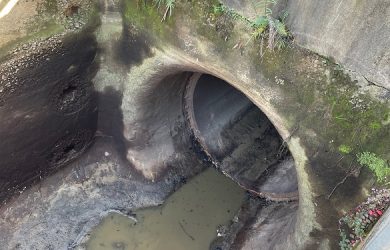
Example of leaking pipe joint
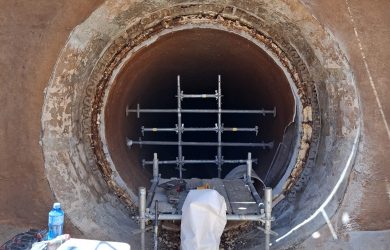
Preparing the surface of the pipe and headwall
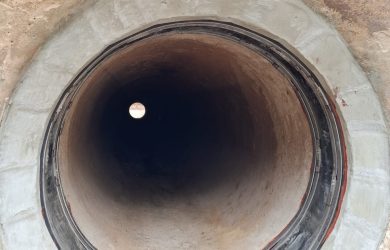
One of the installed HydraTite Seals 2025